
Cricket farming is increasingly recognized as a promising model in modern agriculture. With outstanding advantages, this system offers sustainable income opportunities for livestock producers.
In recent years, cricket farming has gradually become a new direction in rural livestock production. From a small insect commonly found in fields, crickets have now become a stable source of income for many households. With characteristics such as easy husbandry, low investment cost, rapid turnover, and an expanding market, cricket farming is truly a model worth considering.
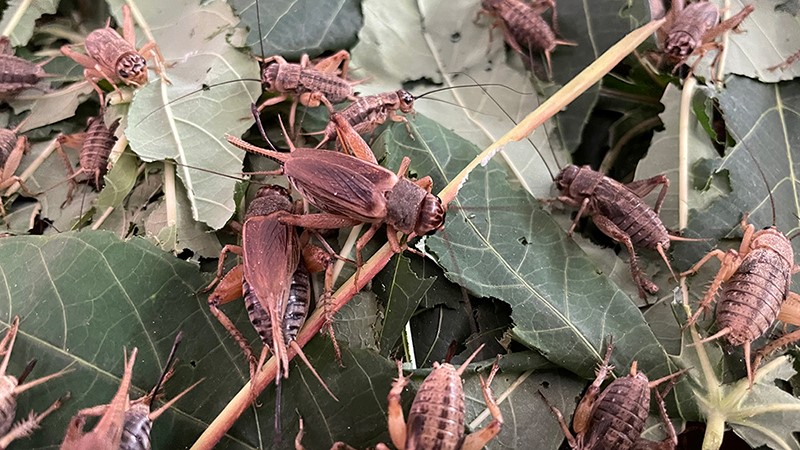 Image of cricket farming
1. WHY CRICKET FARMING IS BECOMING A TREND?
Traditionally, livestock farming was associated with chickens, pigs, cattle, or ducks. However, in recent years, rising input costs, complex disease outbreaks, and challenges in conventional livestock have driven farmers to seek more sustainable alternatives—of which cricket farming stands out.
Crickets are omnivorous insects with fast growth rates, require little space, and are particularly resistant to common diseases. Each production cycle takes only 30–50 days, allowing 7–8 cycles per year. At around 60 days of age, crickets reach sexual maturity and can be paired for breeding. Adult crickets measure approximately 2 cm, with 800–1,000 insects per kilogram.
Crickets serve various markets: human consumption, specialty dishes, fishing bait, feed for ornamental birds, aquarium fish, and reptiles. Thanks to this diversity, market demand for crickets is increasingly stable.
2. HOUSING AND EQUIPMENT PREPARATION
Crickets do not require high investment. They can be raised in styrofoam boxes, plastic bins, wooden containers, or cement tanks. Depending on the scale, each rearing tank may range from 1–2 m² in area and 40–60 cm in height.
The tank should be lined with dry soil, rice husks, or shredded paper to create hiding places. Additionally, cardboard sheets or egg trays should be placed inside to provide climbing surfaces and reduce cannibalism.
The housing environment must be well-ventilated, free from direct drafts, and protected from direct sunlight, as crickets are sensitive to heat. The optimal temperature range is 26–32°C, with humidity maintained at 70–80%. In cold seasons, tanks should be covered, and mild heating lamps may be used.
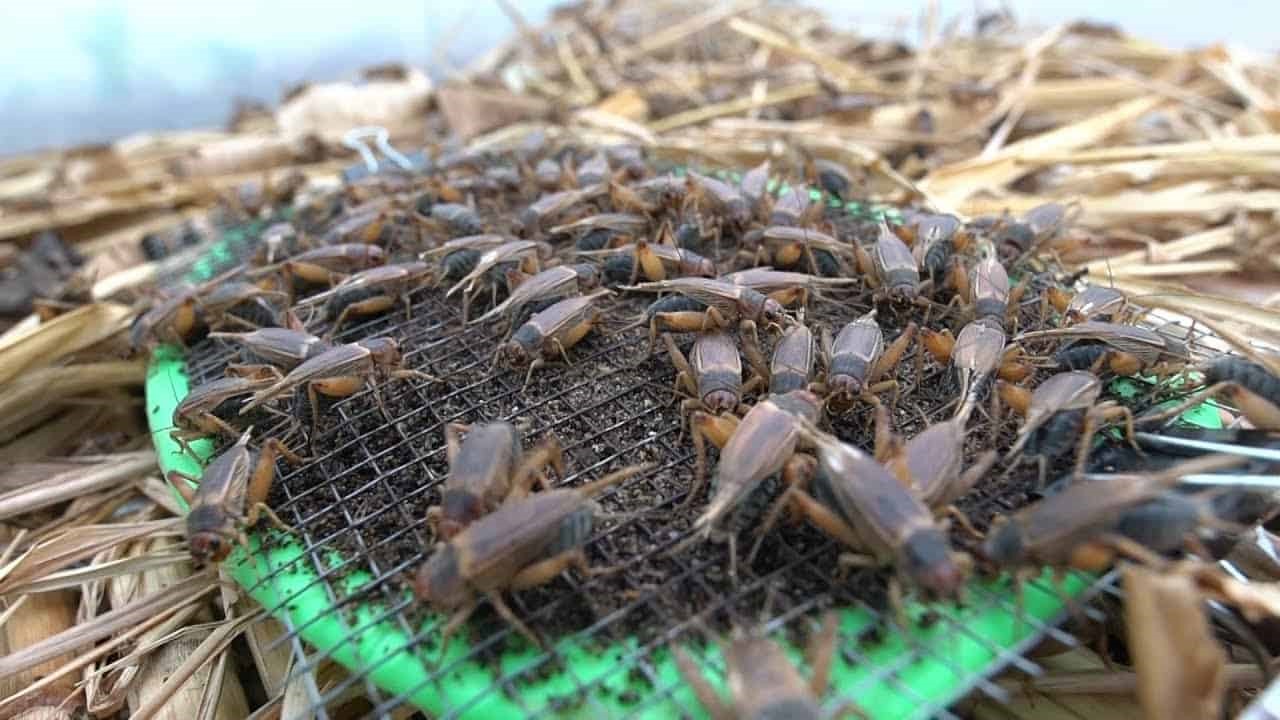 Image of cricket farming
3. BREED SELECTION AND STOCKING
Select healthy breeder crickets with no deformities, showing active movement and shiny bodies. Ideally, choose young adult males (recently chirping) and large, healthy females that have not yet reproduced.
A single female lays approximately 400–500 eggs per cycle. Eggs hatch after 7–10 days. During hatching, maintain high humidity, avoid strong light, and restrict feeding to prevent digestive stress.
Newly hatched nymphs are fragile and require careful management. After around 10 days, when juveniles have hardened and become more active, stocking density should be reduced to avoid cannibalism. The recommended density is 1,000–1,200 nymphs per square meter.
4. FEEDING – SIMPLE AND EFFECTIVE
Crickets are easy to feed. Their diet consists mainly of leafy greens, rice bran, water spinach, cassava leaves, and young grasses. Agricultural by-products such as leftover vegetables, soybean curd residue, or corn stalks can also be used to reduce feeding costs.
Feed must always be dry and clean, as moldy feed can cause mass mortality. Feed crickets twice daily—morning and afternoon—in appropriate amounts to avoid leftovers.
Humidity can be maintained by light mist spraying for drinking water.
5. DISEASE PREVENTION AND MANAGEMENT
Although crickets are generally hardy, poor environmental conditions can lead to mass mortality due to mold contamination, feed poisoning, or parasitic fungi. Therefore, proper hygiene, feed quality control, and consistent environmental management are crucial to preventing disease.
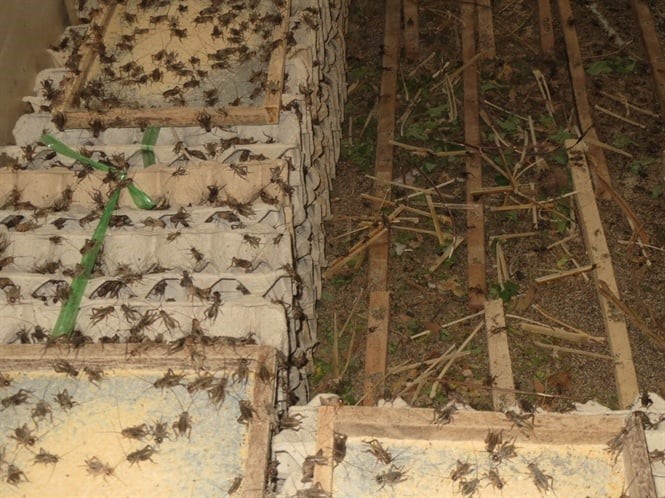 Image of cricket farming
6. HARVESTING AND MARKET DISTRIBUTION
After 30–40 days, crickets reach market size: 2–3 cm in length, with hardened wings and strong legs. At this stage, they can be harvested using mesh nets.
For long-distance transport, crickets can be packed in ventilated styrofoam boxes with added grass to reduce stress and mortality.
7. PRACTICAL EXPERIENCE
Avoid raising crickets during extreme weather conditions. Below 20°C, growth slows; above 35°C, mass mortality is likely.
Inspect rearing tanks daily to identify dead crickets or mold early.
Maintain strict hygiene, especially during the early nymph stages.
Beginners should start with 2–3 small tanks to learn techniques and test the market before scaling up.
For stable market outlets, farmers can partner with bird breeders, aquarium fish farms, or food-processing buyers specializing in edible insects.
The cricket farming model offers high economic efficiency, low production costs, and minimal risk, making it highly suitable for development within modern livestock systems. When proper husbandry techniques are applied and market outlets are proactively secured, producers can establish a stable and sustainable source of income.