
Common carp are fed faba beans for approximately 3–5 months before harvest, transforming them into “crunchy carp.” So, why is this special type of fish so popular among farmers?
Recently, crunchy carp has become a favorite dish among many consumers at restaurants and eateries. The fish no longer has a strong fishy taste but instead has a firm, crunchy texture that is highly appealing. Because the commercial value of crunchy carp is significantly higher than that of common carp, many carp farmers have switched to raising crunchy carp for greater economic value. So, what is the secret to raising crunchy carp effectively?
Before harvest, common carp are fed a special type of feed, namely faba beans (also known as red flat beans or broad beans), for approximately 3–5 months, turning them into crunchy carp. This type of fish has firm flesh and skin, with a distinctive crunchy texture and flavor.
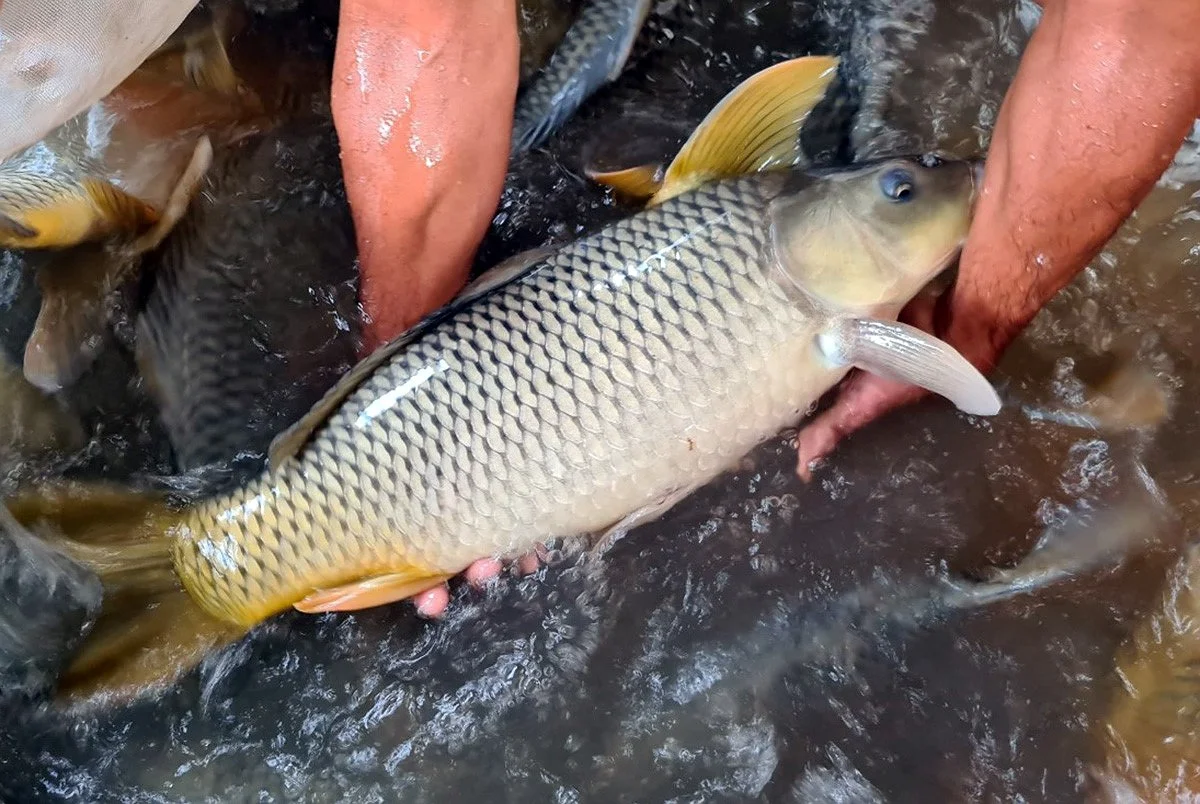 Image of crunchy carp
1. FIRST STEP: PREPARING THE POND OR FISH CAGE
Ponds and fish cages should be located and designed in areas with clean water sources, with no industrial, agricultural, or domestic wastewater flowing into them.
For ponds: The culture pond should have an area of 2,000–5,000 m²:
– Improve and level the pond bottom, with a slope toward the drainage outlet. The pond should be deeper than 2 m, with a water depth of 1.5–2 m. For crunchy carp, the pond should be equipped with devices to create water currents, such as water pumps or paddle wheel aerators. This is an important factor that encourages the fish to swim and remain active frequently, thereby helping the flesh become firm and crunchy more quickly.
– Note: Completely drain the pond and remove the sludge before stocking fish. Use lime to improve the pond bottom and eliminate unwanted organisms at a dosage of 7–10 kg/100 m², then to dry under sunlight for 3–5 days. After pond preparation, fill the pond with sufficient water to a depth of 1.5–1.8 m. The incoming water must be clean and uncontaminated, and turbid water should be avoided. Disinfect the water source with A BENZACID 800.
For fish cages: If the fish cage is large, select a location with a water depth of 3.5–4 m. The cage should be floating and securely anchored at a suitable location on the river, where there is continuous water flow and relatively stable water levels. The river water level should be 0.3–0.5 m higher than the submerged height of the cage.
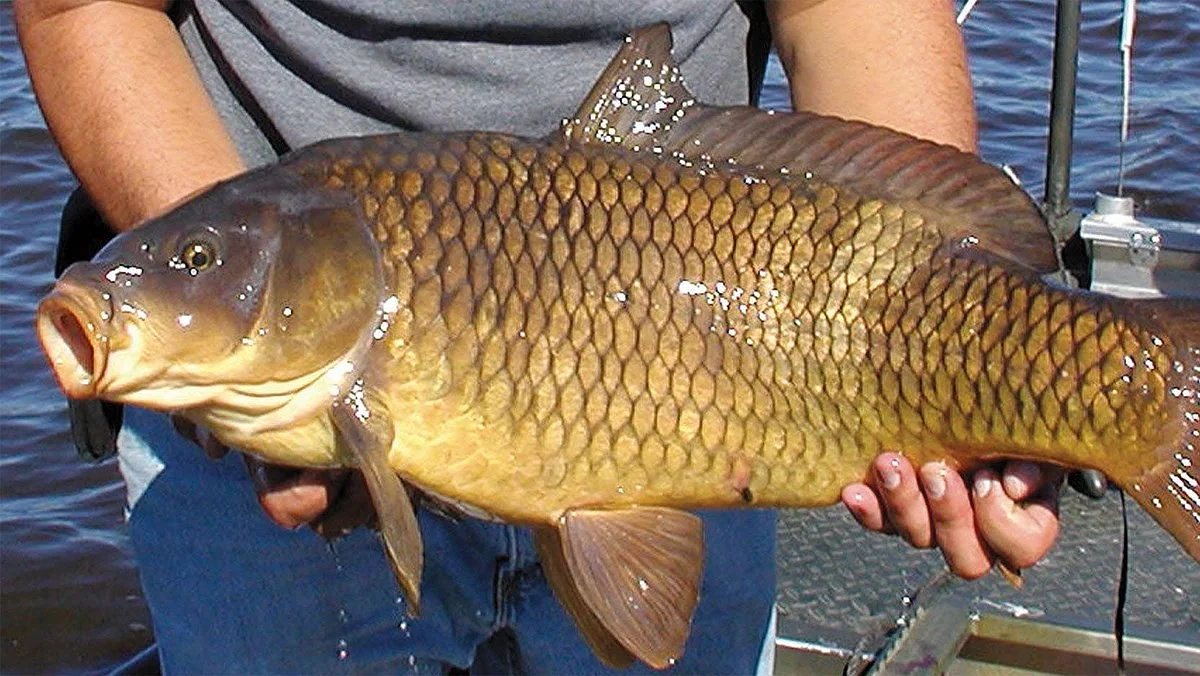 Image of crunchy carp
2. STOCKING METHOD AND DENSITY
– Before carrying out operations such as transporting fish to a new pond or cage or reducing stocking density, the fish should be fasted for approximately 1 day. Suitable weather for transporting fish is during cool periods, early morning, or late afternoon.
– The fish selected for stocking must have complete fins and scales, no abrasions or injuries, and an intact mucus layer. The fish should be uniform in size, active, agile, and swim rapidly in schools below the water surface, with no signs of disease.
– This species can be raised for 1–2 production cycles per year, with each cycle lasting 3–5 months. Fish selected for culture should have a large size of 1.2–1.8 kg. A suitable stocking density is 0.5–1 fish/m² in ponds and 5–7 fish/m³ in cages, depending on management and husbandry conditions.
– After approximately 9 months, when the fish reaches more than 1 kg, farmers begin the fattening stage using faba beans to determine the desired firmness of the fish flesh.
3. FABA BEAN FEEDING PRACTICES
– Feed preparation: Before feeding, soak the faba beans in water for 12–24 hours, depending on air temperature. Large beans should be cut in half. Then wash them thoroughly and mix with 1–2% salt. Allow the mixture to stand for 10–15 minutes before feeding. This is a commonly used feed preparation method in common carp farming.
– Feeding: It is recommended to train the carp to consume faba beans by fasting the fish and providing no feed for 5 days. After that, begin feeding faba beans. During the following 5 days, feed faba beans at a rate of 0.03% of body weight at 4:00 p.m., as this is considered a suitable time for feed intake and digestion. The feeding rate is then gradually increased to 1.5–3.0% of the total fish biomass in the pond.
Note: Feed intake should be closely monitored every day using a feeding tray.
The key factor determining the crunchy texture and delicious flavor of carp is faba beans.
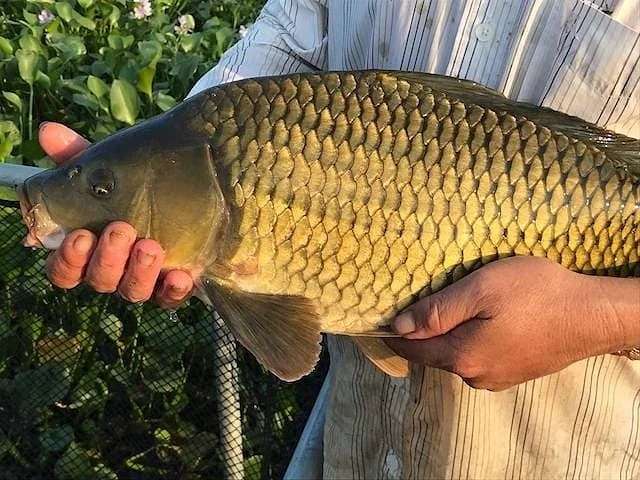 Image of crunchy carp
4. CULTURE TECHNIQUES
– During the initial period, the fish should not be given any feed other than faba beans. Approximately 3 hours after feeding, check whether the fish have consumed all the feed and whether feed intake is high or low, so that the feeding rate can be adjusted promptly and appropriately.
– Faba beans tend to sink quickly. Therefore, when feeding, distribute them in small amounts at a time to avoid feed waste, and adjust the daily feeding amount according to the fish’s feeding demand.
– Standard carp farming practice is to feed the fish twice a day, at 8:00–10:00 a.m. and 4:00–6:00 p.m. The feed should be placed in a feeding tray positioned at the bottom of the pond or cage. The tray is made from a metal frame with a diameter of 6 cm, an area of 4–5 m², and a height of 25–30 cm. The tray should be surrounded by two layers: one layer of wire mesh and one layer of nylon netting to prevent the beans from drifting outside.
Note: The feeding trays should be cleaned periodically, at least twice a month, to improve disease prevention and maintain good fish health.
5. DISEASE PREVENTION
Periodically, once a month, certain antibiotics (A OXYLINE 200S and A ERYCIN 500S) should be supplemented as a preventive measure, continuously for 3 days. In addition, finely ground garlic can be used at a rate of 3–5 g/kg of feed. Vitamin C, such as A VITA C MAX, may also be used.
Remember to inspect the fish in the pond or cage. Once the fish have reached the desired level of flesh firmness and crunchiness, proceed with harvesting. Remember to fast the fish for 1 day before harvest.
Switching to crunchy carp farming not only provides higher economic value but also offers a more stable market outlet when the fish meets the quality requirements for commercial sale.
The information above provides an explanation of the method for transforming common carp into crunchy carp. Hopefully, farmers can choose a suitable farming model that delivers greater economic efficiency.